
According to Wednesday's quarterback stat projection, I have to account for 218 receptions, 2,760 yards and 17 touchdowns for the pass catchers. This includes the bevy of inexperienced wide receivers, the cluster of unproven running backs and the solid, steady and reliable corps of tight ends.
Last year, the receivers caught 184 passes for 2,383 yards and 13 touchdowns in the regular season.
The Tech offense usually uses its tight ends about as often as Travis Henry uses protection. However, you have to figure they'll see a few more balls their way since Sam Wheeler was on his way to becoming a favorite target of Glennon's before tearing his ACL and because everyone else is so green.
As for the receivers, I think Zach Luckett will emerge as the go-to guy with the former quarterbacks, Ike Whitaker and Cory Holt also emerging as targets. As for the running backs, Kenny Lewis appears to be the best pass-catcher among them, although Ryan Williams could see the field as a flanker early in the season.
For the purpose of this projection, we'll look at the five receivers I expect to make the biggest impact in 2008 (Luckett, Whitaker, Holt, Dyrell Roberts and Danny Coale), the top two tight ends (Wheeler and Greg Boone) and the top two running backs (Lewis and Williams). We'll assume those nine will account for 200 receptions, 2,670 yards and 17 touchdowns and 18 receptions and 90 yards going to other players in mop-up duty, etc.
Regular Season Only
Wide Receivers
Zach Luckett in 2008
45 Rec, 710 Yds, 5 TDs
15.8 Ypc
Ike Whitaker in 2008
35 Rec, 480 Yds, 3 TDs
13.7 Ypc
Danny Coale in 2008
25 Rec, 320 Yds, 2 TDs
12.8 Ypc
Dyrell Roberts in 2008
15 Rec, 220 Yds, 1 TD
14.7 Ypc
Cory Holt in 2008
15 Rec, 190 Yds, 0 TDs
12.7 Ypc
Tight Ends
Sam Wheeler
25 Rec, 360 Yds, 3 TDs
14.4 Ypc
Greg Boone
10 Rec, 145 Yds, 1 TD
14.5 Ypc
Running Backs
Kenny Lewis
20 Rec, 160 Yds, 1 TD
8.0 Ypc
Ryan Williams
10 Rec, 85 Yds, 1 TD
8.5 Ypc
Showing posts with label statgasms. Show all posts
Showing posts with label statgasms. Show all posts
Friday, August 15, 2008


Thursday, August 14, 2008
2008 VT Stat Projection: Running Backs
In Monday's stat projection for the offense as a whole I predicted the Hokies to average 155 yards per game on the ground. Multiply that by 12 regular season games and that's 1,860 rushing yards that need to be accounted for by Virginia Tech's ball-carriers.
Last year, the Hokies tallied 1,638 rushing yards on 482 carries (3.4 Ypc) in their 12 regular season games. How will the Hokies average 155 yards per game this year? Easy. I think the yards per carry will up significantly in 2008. The offensive line is much better and with Tyrod Taylor scrambling for yards, you'll see a significant rise in yards per carry.
If you read Wednesday's stat projection for the quarterbacks, you saw that I predict the Hokies to throw four more passes per game this year as opposed to last. Lets say the Hokies run the same number of plays this year as last year. That means they would have to rush for 1,860 yards on 438 carries in 2008. That puts the team yards per carry at 4.2 yards per carry, an improvement of almost a full yard over last year's team.
Again, I think this is possible because of Tyrod's rushing ability, the improved offensive line, and fewer sacks taking away from the yards per carry. Basically, you'll see a lot fewer carries for Glennon this year. He had 66 in 2007.
I'll focus the individual projections on the four players I think will get the most carries in 2008: Kenny Lewis, Jahre Cheeseman, Tyrod Taylor and Ryan Williams. While Darren Evans and Josh Oglesby are good players, there just aren't enough carries for them.
Between mop-up time rushing yards, rushing yards for receivers and quarterback sacks, the Hokies had 112 rushing yards on that weren't accounted for by the top four rushers. I think that will stay the same this year (less reverses but less sacks). Since there are more backs competing for mop-up yards (but mostly to keep these numbers round), let's say the top four rushers for the Hokies need to combine for 1,740 yards (120 yards to others) on 390 carries (48 to others) in 2008. That would be just under 4.5 yards per carry. Last year, the top four rushers for the Hokies had 1,524 yards on 385 carries during the regular season (4.0 Ypc).
Regular Season Only
Tyrod Taylor in 2008
90 Car, 550 Yds, 6.1 Ypc, 7 TD
Jahre Cheeseman in 2008
140 Car, 550 yds, 3.9 Ypc, 7 TD
Kenny Lewis in 2008
90 Car, 320 yds, 3.5 Ypc, 3 TD
Ryan Williams in 2008
70 Car, 320 yds, 4.5 Ypc, 4 TD
I think you will see Cheeseman as the primary back early in the year with more and more of his carries going to Williams as the season progresses. Lewis will stay in the same role as the third down back or change of pace back for the duration of the season.
Last year, the Hokies tallied 1,638 rushing yards on 482 carries (3.4 Ypc) in their 12 regular season games. How will the Hokies average 155 yards per game this year? Easy. I think the yards per carry will up significantly in 2008. The offensive line is much better and with Tyrod Taylor scrambling for yards, you'll see a significant rise in yards per carry.
If you read Wednesday's stat projection for the quarterbacks, you saw that I predict the Hokies to throw four more passes per game this year as opposed to last. Lets say the Hokies run the same number of plays this year as last year. That means they would have to rush for 1,860 yards on 438 carries in 2008. That puts the team yards per carry at 4.2 yards per carry, an improvement of almost a full yard over last year's team.
Again, I think this is possible because of Tyrod's rushing ability, the improved offensive line, and fewer sacks taking away from the yards per carry. Basically, you'll see a lot fewer carries for Glennon this year. He had 66 in 2007.
I'll focus the individual projections on the four players I think will get the most carries in 2008: Kenny Lewis, Jahre Cheeseman, Tyrod Taylor and Ryan Williams. While Darren Evans and Josh Oglesby are good players, there just aren't enough carries for them.
Between mop-up time rushing yards, rushing yards for receivers and quarterback sacks, the Hokies had 112 rushing yards on that weren't accounted for by the top four rushers. I think that will stay the same this year (less reverses but less sacks). Since there are more backs competing for mop-up yards (but mostly to keep these numbers round), let's say the top four rushers for the Hokies need to combine for 1,740 yards (120 yards to others) on 390 carries (48 to others) in 2008. That would be just under 4.5 yards per carry. Last year, the top four rushers for the Hokies had 1,524 yards on 385 carries during the regular season (4.0 Ypc).
Regular Season Only
Tyrod Taylor in 2008
90 Car, 550 Yds, 6.1 Ypc, 7 TD
Jahre Cheeseman in 2008
140 Car, 550 yds, 3.9 Ypc, 7 TD
Kenny Lewis in 2008
90 Car, 320 yds, 3.5 Ypc, 3 TD
Ryan Williams in 2008
70 Car, 320 yds, 4.5 Ypc, 4 TD
I think you will see Cheeseman as the primary back early in the year with more and more of his carries going to Williams as the season progresses. Lewis will stay in the same role as the third down back or change of pace back for the duration of the season.
Wednesday, August 13, 2008
2008 VT Stat Projection: Quarterbacks
In Monday's projection for the offense as a whole I said the Hokies will average 230 yards per game this year through the air. Multiply that by 12 regular season games and you get 2,760 passing yards that need to be accounted for by the two quarterbacks.
As I've said all along, I expect the dual-quarterback system to win out with Glennon as the starter getting most of the snaps. I expect he'll flourish in his senior year and collect about 65-70 percent of the Hokies' passing yards. Tyrod will obviously have a lot more yards on the ground because that's what the Hokies will need from him.
Last year, Glennon threw for 1,462 yards in the regular season while Tyrod threw for 888.
Regular season only
Sean Glennon 2008
145-225, 1,800 Yds, 11 TD, 4 INT
64.4 Comp%, 8.0 Ypa
Tyrod Taylor 2008
73-128, 960 yds, 6 TD, 3 INT
57.0 Comp%, 7.5 Ypa
Last season, Glennon completed 60.9 percent of his passes and averaged 7.5 yards per attempt. Tyrod completed 53.7 percent of his passes and averaged 6.9 yards per attempt.
Last year Glennon and Taylor combined to throw 305 passes in the 12 regular season games. This projection has them combining for 353 passes. That's an increase of four passes per game. I believe this is reasonable because Glennon will be be involved more than last year, where he didn't play in one game and barely saw action in four others. In 2006, he threw 276 passes in the 12 regular season games he started.
Also, the Hokies' running back situation will call for more passes. All five potential backs are unproven or have no previous game experience.
These numbers would give Glennon just over 65 percent of the passing yards and almost 64 percent of the passing attempts. Will that be enough to placate the redshirt senior and third year starter? If the team's winning, probably. If it's not, changes will be made, one way or another and feelings will be hurt. But, that's the risk with the two-quarterback system. When the team's winning, everyone's happy. When it's not, no one is.
As I've said all along, I expect the dual-quarterback system to win out with Glennon as the starter getting most of the snaps. I expect he'll flourish in his senior year and collect about 65-70 percent of the Hokies' passing yards. Tyrod will obviously have a lot more yards on the ground because that's what the Hokies will need from him.
Last year, Glennon threw for 1,462 yards in the regular season while Tyrod threw for 888.
Regular season only
Sean Glennon 2008
145-225, 1,800 Yds, 11 TD, 4 INT
64.4 Comp%, 8.0 Ypa
Tyrod Taylor 2008
73-128, 960 yds, 6 TD, 3 INT
57.0 Comp%, 7.5 Ypa
Last season, Glennon completed 60.9 percent of his passes and averaged 7.5 yards per attempt. Tyrod completed 53.7 percent of his passes and averaged 6.9 yards per attempt.
Last year Glennon and Taylor combined to throw 305 passes in the 12 regular season games. This projection has them combining for 353 passes. That's an increase of four passes per game. I believe this is reasonable because Glennon will be be involved more than last year, where he didn't play in one game and barely saw action in four others. In 2006, he threw 276 passes in the 12 regular season games he started.
Also, the Hokies' running back situation will call for more passes. All five potential backs are unproven or have no previous game experience.
These numbers would give Glennon just over 65 percent of the passing yards and almost 64 percent of the passing attempts. Will that be enough to placate the redshirt senior and third year starter? If the team's winning, probably. If it's not, changes will be made, one way or another and feelings will be hurt. But, that's the risk with the two-quarterback system. When the team's winning, everyone's happy. When it's not, no one is.
Tuesday, August 12, 2008
2008 VT Stat Projection: Defense

Lot of new faces out there. Two new starters in the secondary. Another, Kam Chancellor, is at a new position. Two new starters at linebacker, although both are redshirt seniors. Three new starters on the defensive line and not much depth at defensive tackle.
This will be the big test of Bud Foster's abilities as a defensive coordinator. He's earned the reputation as one of the best, if not THE best in the country. If he cranks out another Top 10 defense this year, he's King Bud in my book.
While I believe the defense won't be as stout as the last four years (how could it?), it won't be a significant step down. Foster's an excellent coach and the Hokies have much better talent than they did in 2003, the year of which we will not speak.
My primary concern is at defensive tackle. Although, freshman Vinston Painter's move from the offensive line to defensive tackle alleviates some of that concern. He will provide depth and from all reports, he's going to be an excellent player.
The linebackers won't be as athletic as the last four years, but they'll get the job done. The pressure will be on the secondary to maintain its dominance. The linebackers helped a lot in pass coverage last year.
However, I think the Hokies will put a lot of pressure on the quarterback, which will help the secondary out. Should be a solid year for the defense. Last year, the Hokies gave up 296.93 yards per game, good enough for No. 4 in the country and No. 1 in the ACC. It was the third consecutive year the Hokies led the ACC in total defense and the fourth consecutive year the Hokies led the conference in scoring defense.
2008 Hokies Rush Defense: 115.0 YPG
2008 Hokies Pass Defense: 200.0 YPG
2008 Hokies Total Defense: 315.0 YPG
If the Hokies had given up 315.0 YPG in 2007 they would have ranked No. 12 in the country in total defense. I think the rush yards per game will be higher this season because the front seven is inexperienced and faces more run-oriented teams this year in Nebraska and the new Georgia Tech. They last gave up that many YPG on the ground in 2004, when they gave up 115.23 YPG rushing, ranking No. 21 in the country. That year, they faced teams with tremendous rushing offenses like USC and Auburn. NC State also had TA McClendon that year.
Still, a defense ranked in the Top 15 would be good for this team if the offense is able to improve as I think it will.
Monday, August 11, 2008
2008 VT Stat Projection: Offense

Last year, the Hokies were No. 100 in the country in total offense and still won 11 games. Their 330.5 yards per game was good enough for 8th in the conference. However, their 28.71 points per game was 2nd behind Clemson. How? The defense. Directly or indirectly, the Tech defense helped account for a lot of points.
It wasn't just Beamerball with non-offensive touchdowns. It was creating turnovers and winning the field position battle. The Hokies worked with a short field a lot in 2007 and it attributed to both the high ranking in points per game and the low ranking in yards per game.
Of course, it didn't help that for the first half of the season the offense was inept at best. But this year, we should see a more effective offense even without any returning starters at running back or wide receiver.
The offensive line is greatly improved. It's light-years ahead of where the Hokies were at O-line last year. There will be holes for running backs to run through and I expect them to find them. There will be time for the quarterback to make decisions and I expect them to make the right ones. The O-line dictates everything on offense and Tech has a solid front.
So, on with the projections for the Hokies on offense.
Last year, Tech averaged 133.64 yards per game rushing and 196.86 yards per game passing. Those numbers won't be significantly higher, but I believe they will be improved.
2008 Hokie Rushing Yards: 155.0 YPG
2008 Hokie Passing Yards: 230.0 YPG
2008 Hokie Total Yards: 380.0 YPG
A caveat here: I think Tyrod Taylor will get a lot of rushing yards. I think he will end up splitting time with Sean Glennon and we'll see Tyrod use his feet. Also, with the improved offensive line, there will be fewer sacks. Glennon "rushed" for (-43) yards last year thanks mainly to sacks.
Glennon, meanwhile, won't have the same targets he had to throw to last year. However, he'll be upright a lot more than last year and when you give Glennon time to throw he's pretty good.
Last year, 385.0 YPG would have put the Hokies at No. 69 in the nation. That would be a big improvement over the last couple of years. It would also alleviate some pressure on offensive coordinator Bryan Stinespring, who a lot of Hokie fans can't stand. Yes, the offense is stale and often depressing. But for the athletes Tech has, it works. Other than Lee Suggs and Kevin Jones, the offense hasn't been very talented since Michael Vick left after the 2000 season.
The Hokies Under Stinespring
2007: 330.50 YPG - No. 100 NCAA - No. 8 ACC
2006: 295.15 YPG - No. 99 NCAA - No. 9 ACC
2005: 380.92 YPG - No. 57 NCAA - No. 4 ACC
2004: 365.54 YPG - No. 65 NCAA - No. 4 ACC
2003: 401.77 YPG - No. 38 NCAA - No. 3 BE
2002: 371.64 YPG - No. 64 NCAA - No. 5 BE
I'm not a complete Stiney detractor. By all accounts he's a great guy and Coach Beamer trusts him. But how many offensive coordinators have been outside the Top 50 in total offense every year but one for the last six years and kept their jobs?
Stinespring hasn't had the talent the produce a top offense at Virginia Tech, but he might soon. If the offense improves this year he will get the chance to coach those players. But if the offense is again ranked as low as it has been the last two years, will the heat on him be enough that Beamer will move on? I think it might.
If the offense improves like I think it will this year, I think it will keep improving. The Hokies are finally starting to get top talent on offense with Tyrod, Ryan Williams and Dyrell Roberts. The future finally looks bright on the offensive side of the ball.
Monday, May 19, 2008
The Importance of Turnovers
If you out-rush your opponent, have fewer turnovers than your opponent and put pressure on the opposing quarterback, you'll win almost every college football game you're in. Tech's running game has already been discussed. As for the other two, well, one can be a byproduct of the other. If you're able to put pressure on the quarterback, you're able to force him into making decisions he wouldn't otherwise making and possibly force an interception on a bad throw or a fumble on a sack.
Winning the turnover battle requires solid play from both the offense and defense, just like out-rushing the opponent. However, out-rushing the opponent is more indicative of how both teams' lines played through the whole game. Turnovers can often have a more immediate impact on the game.
Turnovers have an effect on field position, momentum and the crowd. An interception by the home team can ignite the crowd and give momentum to the offense that wasn't there previously. By contrast, a fumble in the red zone by the home team can silence a frenzied fan base. Turnovers can also lead directly to points, as every Hokie fan knows.
So why is it important for the Hokies to have more takeaways that giveaways? Simple. Tech has not lost a game in which the opposition committed more turnovers than the Hokies since 2004. The Hokies lost at home to NC State despite forcing two turnovers and committing one. Since then, they've rattled off 28 consecutive wins when forcing more turnovers than they've committed.
Here it is by season since the Hokies joined the ACC in 2004:
ACC games in parenthesis
Committing fewer turnovers
2004: 6-1 (4-1)
2005: 8-0 (4-0)
2006: 8-0 (4-0)
2007: 7-0 (6-0)
Total: 29-1 (18-1)
Committing more or equal turnovers
2004: 4-2 (3-0)
2005: 3-2 (3-2)
2006: 2-3 (2-2)
2007: 4-3 (2-2)
Total: 13-10 (10-6)
Turnovers can also explain the Hokies' struggle in recent bowls. Since joining the ACC, Tech's only bowl win was in the 2006 Gator Bowl over Louisville. In that game, Tech forced four turnovers and didn't commit any. The Hokies forced Card QB Hunter Cantwell to throw three interceptions, the last of which was returned for a game-clinching touchdown in their 35-24 win.
However, in the three losses, the Hokies lost the turnover battle by a combined total of 9-4, including 7-2 in the last two bowls against Georgia and Kansas.
An important part of winning the turnover battle is the quarterback. It's important to have a smart quarterback capable of managing the game and not committing dumb turnovers. Sean Glennon has filled this role for the most part, but has had two bad outings in bowl games. He threw three in the Peach Bowl loss to Georgia and two more in the Orange Bowl loss to Kansas.
While Glennon has laid two eggs in bowls, he is responsible for the Hokies winning the turnover battle in a lot of their games. He doesn't force passes that aren't there, he doesn't throw into double coverage and when he misses, he's typically putting the ball where only his receive has a chance to make the catch.
Tyrod Taylor, being a mobile quarterback, is by nature going to commit more turnovers than a pocket quarterback. This is because mobile quarterbacks carry the ball more often and are more susceptible to fumbles. He threw three interceptions last year, only one of which had enough negative impact to have an effect on the game. But what an effect it had.
The other key component to turnovers are the defensive ends. They're the ones applying pressure to the quarterback, forcing interceptions and fumbles. And fortunately for the Hokies, they have had some great ones the last four years. Jim Davis, Noland Burchette, Darryl Tapp and Chris Ellis were about as good as you could ask for over a four-year period. This year, it's up to Orion Martin, Jason Worilds and Nekos Brown to continue the tradition.
The Hokies should have another good year in the turnover battle in 2008. They have a solid group of defensive ends and two playmakers in the secondary in Macho Harris and Kam Chancellor who can force interceptions. They also have two quarterbacks who aren't going to force things that aren't there and cost the Hokies a game with a dumb giveaway.
Winning the turnover battle requires solid play from both the offense and defense, just like out-rushing the opponent. However, out-rushing the opponent is more indicative of how both teams' lines played through the whole game. Turnovers can often have a more immediate impact on the game.
Turnovers have an effect on field position, momentum and the crowd. An interception by the home team can ignite the crowd and give momentum to the offense that wasn't there previously. By contrast, a fumble in the red zone by the home team can silence a frenzied fan base. Turnovers can also lead directly to points, as every Hokie fan knows.
So why is it important for the Hokies to have more takeaways that giveaways? Simple. Tech has not lost a game in which the opposition committed more turnovers than the Hokies since 2004. The Hokies lost at home to NC State despite forcing two turnovers and committing one. Since then, they've rattled off 28 consecutive wins when forcing more turnovers than they've committed.
Here it is by season since the Hokies joined the ACC in 2004:
ACC games in parenthesis
Committing fewer turnovers
2004: 6-1 (4-1)
2005: 8-0 (4-0)
2006: 8-0 (4-0)
2007: 7-0 (6-0)
Total: 29-1 (18-1)
Committing more or equal turnovers
2004: 4-2 (3-0)
2005: 3-2 (3-2)
2006: 2-3 (2-2)
2007: 4-3 (2-2)
Total: 13-10 (10-6)
Turnovers can also explain the Hokies' struggle in recent bowls. Since joining the ACC, Tech's only bowl win was in the 2006 Gator Bowl over Louisville. In that game, Tech forced four turnovers and didn't commit any. The Hokies forced Card QB Hunter Cantwell to throw three interceptions, the last of which was returned for a game-clinching touchdown in their 35-24 win.
However, in the three losses, the Hokies lost the turnover battle by a combined total of 9-4, including 7-2 in the last two bowls against Georgia and Kansas.
An important part of winning the turnover battle is the quarterback. It's important to have a smart quarterback capable of managing the game and not committing dumb turnovers. Sean Glennon has filled this role for the most part, but has had two bad outings in bowl games. He threw three in the Peach Bowl loss to Georgia and two more in the Orange Bowl loss to Kansas.
While Glennon has laid two eggs in bowls, he is responsible for the Hokies winning the turnover battle in a lot of their games. He doesn't force passes that aren't there, he doesn't throw into double coverage and when he misses, he's typically putting the ball where only his receive has a chance to make the catch.
Tyrod Taylor, being a mobile quarterback, is by nature going to commit more turnovers than a pocket quarterback. This is because mobile quarterbacks carry the ball more often and are more susceptible to fumbles. He threw three interceptions last year, only one of which had enough negative impact to have an effect on the game. But what an effect it had.
The other key component to turnovers are the defensive ends. They're the ones applying pressure to the quarterback, forcing interceptions and fumbles. And fortunately for the Hokies, they have had some great ones the last four years. Jim Davis, Noland Burchette, Darryl Tapp and Chris Ellis were about as good as you could ask for over a four-year period. This year, it's up to Orion Martin, Jason Worilds and Nekos Brown to continue the tradition.
The Hokies should have another good year in the turnover battle in 2008. They have a solid group of defensive ends and two playmakers in the secondary in Macho Harris and Kam Chancellor who can force interceptions. They also have two quarterbacks who aren't going to force things that aren't there and cost the Hokies a game with a dumb giveaway.
Thursday, May 1, 2008
Comparing Glennon to Randall

I'll admit I've been harsh on Sean Glennon in the past. I was anything but a Glennon supporter going into the 2006 season and after that year's BC game, I gave up on him. I considered 2006 to be a lost season and Glennon to be the second-coming of Grant Noel.
But then Glennon and the Hokies rattled off six consecutive wins and led Georgia 21-3 at halftime of the Peach Bowl (We don't use corporate names here. It's still Peach and Citrus to me.). However, after a dismal second half against Georgia led to a 31-24 loss, Glennon was again in the dog house to Hokie fans.
The arrival of Tyrod Taylor to Blacksburg didn't help Glennon's cause either. Fans and media anointed Taylor the QB of the future and considered Glennon a caretaker of the position until the true freshman was ready. Glennon's every move was dissected and criticized.
But there's a problem. Glennon's a really good quarterback. He's won a lot of games for Virginia Tech and leads an effective offense. No, the offense isn't nearly as sexy as when Taylor's behind center, but Glennon is more efficient.
When I think back on it, my opinion of Glennon was the same of my opinion of Bryan Randall. I wasn't a big Randall fan until just before the 2004. Season. The Hokies had collapsed in the second half of the 2002 and 2003 seasons with him as the quarterback. I was ready to see Randall exit the scene and see Marcus Vick take over as the quarterback.
But then Vick got suspended for the 2004 season and I realized Tech would be better off for it. Randall no longer had to be looking over his shoulder to see if he was going to get pulled. He was a senior who had been through two difficult seasons. In 2002 and 2003, Randall and the Hokies were learning how to win games. And it paid off with a 2004 season that saw Tech win its final eight regular season games and win the ACC in its first year in the conference.
I think its going to be the same way with Glennon. He already has an ACC Championship that I give him a lot of the credit for. Now, I don't hope that Taylor redshirts, is suspended or injured. I hope Taylor plays a lot in 2008 and complements Glennon and the rest of the offense.
But it's my belief Glennon is going to have a great 2008 and gives the Hokies the best chance to do great things. To me, Randall and Glennon's career paths have been similar and I think Glennon will have just as good a senior year as Randall.
Glennon vs. Randall by the numbers:
(For records, I considered games in which the quarterback played the majority of plays).
Freshman Year
Randall: 12-34 (35.3%) 114 yards, 0 TD, 0-0 record
Glennon: 8-11 (72.7%) 137 yards, 1 TD, 0-0 record
Sophomore Year
Randall: 158-248 (63.7%), 2,134 yards, 12 TD, 10-4 record
Glennon: 170-302 (56.3%), 2,191 yards, 11 TD, 10-3 record
Junior Year
Randall: 150-245 (61.2%), 1,996 yards, 15 TD, 8-5 record
Glennon: 143-235 (60.9 %), 1,796 yards, 12 TD, 6-3 record
Senior Year
Randall: 170-306 (55.6%), 2,264 yards, 21 TD, 10-3 record
Glennon: ?
Sophomore and Junior Seasons
(Both started their sophomore and junior seasons)
Totals
Randall: 308-493 (62.5%), 4,130 yards, 27 TD, 18-9 record
Glennon: 312-537 (58.1%), 3,986 yards, 23 TD, 16-6 record
Vs. Conference Opponents
Randall: 158-265 (59.6%), 2,171 yards, 15 TD, 7-7 record
Glennon: 214-355 (60.3%), 2,767 yards, 16 TD, 11-3 record
Friday, April 4, 2008
Why Tech's RB is Important
The Hokies are looking for a new running back during Spring Practice. Senior running back Branden Ore was dismissed from the team March 19, meaning the Hokies will have a new starting running back for the first time since 2005 when Mike Imoh and Cedric Humes split the duties.
I believe the coaches will again split duties until incoming freshman Ryan Williams is ready to take over the full-time starting job. This could be anywhere from four games to two seasons in my estimation. If Williams is as good as Hokie fans want him to be, he could be THE GUY by the Nebraska game. However, if he has trouble adapting to college ball and the Hokies scheme, like many freshman, he may night see significant time on the field until the 2009 season.
The two-headed running back approach has worked for the Hokies in the past, no more so than when they had both Lee Suggs and Kevin Jones in the same backfield. It was a good problem to have. The way many top programs are operating in today's college football world is to have a bruising running back who can go between the tackles and a quick and shifty change-of-pace back who can cut to the outside if necessary.
Whatever Tech decides to do at running back, its important for the offense to have a stable ground attack early. The Hokies struggled on the ground early last season and had trouble dominating games. And history shows just how important it is for the Hokies to own the lines of scrimmage.
A lot of the following also has a lot to do with Tech's defense, as you'll see. The defensive unit is also going through a lot of changes, especially at linebacker. Those issues also need to be addressed early because when Tech out-rushes its opponent, it usually wins.
This is covered in by the fine folks in the Tech media relations department. Tech's record when it out-rushes its opponent is almost always listed early in the weekly game notes. But, we can also dig deeper.
Since joining the ACC in 2004, Virginia Tech had out-rushed its opponent in 39 of 53 games (73.6 percent). In ACC games alone, Tech has out-rushed its opponent in 25 of 34 games (73.5 percent). The high success rate is not based on Tech's typically weak non-conference schedule. However, this last season, the Hokies did out-rush their opponent in all nine games against ACC opponents and were out-rushed by ECU and LSU in non-conference play.
And when Tech out-rushes its opponent, it tends to win. Since 2004, Tech is 36-3 (92.3 percent) when out-rushing its opponent. Two of those losses came in 2007, to BC in Blacksburg and Kansas. Before the LSU game, the only loss Tech had when out-rushing its opponent in the ACC era came in the first game of the era, in 2004 against USC. Against the ACC, Tech went 24-1 (96 percent) when it out-rushed ACC foes.
The Hokies went 31 games without losing in games they had more yards rushing than their opponent.
Record When Out-rushing the Opponent
2004: 8-1 (88.9 percent)
2005: 10-0 (100 percent)
2006: 8-0 (100 percent)
2007: 10-2 (83.3 percent)
Total: 36-3 (92.3 percent)
However, when the Hokies are beaten on the ground, the results typically aren't pretty. Since 2004, Tech is 6-8 (42.9 percent) when it is out-rushed, with three of those losses coming in bowls. The Hokies were 2-3 (40 percent) when out-rushed by non-conference opponents. Those wins came against Kent State in 2006 and ECU in 2007.
Record When Out-rushed by Opponent
2004: 2-2 (50 percent)
2005: 1-2 (33.3 percent)
2006: 2-3 (40 percent)
2007: 1-1 (50 percent)
Total: 6-8 (42.9 percent)
As you can see, a key to the Hokies' winning percentage is their ability to out-rush their opponent, particularly against the ACC. If the Hokies are going to defend their ACC Championship, they need to find a dependable ground attack early. Spring and Fall Practices will be especially important for finding a running back rotation that works.
I believe the coaches will again split duties until incoming freshman Ryan Williams is ready to take over the full-time starting job. This could be anywhere from four games to two seasons in my estimation. If Williams is as good as Hokie fans want him to be, he could be THE GUY by the Nebraska game. However, if he has trouble adapting to college ball and the Hokies scheme, like many freshman, he may night see significant time on the field until the 2009 season.
The two-headed running back approach has worked for the Hokies in the past, no more so than when they had both Lee Suggs and Kevin Jones in the same backfield. It was a good problem to have. The way many top programs are operating in today's college football world is to have a bruising running back who can go between the tackles and a quick and shifty change-of-pace back who can cut to the outside if necessary.
Whatever Tech decides to do at running back, its important for the offense to have a stable ground attack early. The Hokies struggled on the ground early last season and had trouble dominating games. And history shows just how important it is for the Hokies to own the lines of scrimmage.
A lot of the following also has a lot to do with Tech's defense, as you'll see. The defensive unit is also going through a lot of changes, especially at linebacker. Those issues also need to be addressed early because when Tech out-rushes its opponent, it usually wins.
This is covered in by the fine folks in the Tech media relations department. Tech's record when it out-rushes its opponent is almost always listed early in the weekly game notes. But, we can also dig deeper.
Since joining the ACC in 2004, Virginia Tech had out-rushed its opponent in 39 of 53 games (73.6 percent). In ACC games alone, Tech has out-rushed its opponent in 25 of 34 games (73.5 percent). The high success rate is not based on Tech's typically weak non-conference schedule. However, this last season, the Hokies did out-rush their opponent in all nine games against ACC opponents and were out-rushed by ECU and LSU in non-conference play.
And when Tech out-rushes its opponent, it tends to win. Since 2004, Tech is 36-3 (92.3 percent) when out-rushing its opponent. Two of those losses came in 2007, to BC in Blacksburg and Kansas. Before the LSU game, the only loss Tech had when out-rushing its opponent in the ACC era came in the first game of the era, in 2004 against USC. Against the ACC, Tech went 24-1 (96 percent) when it out-rushed ACC foes.
The Hokies went 31 games without losing in games they had more yards rushing than their opponent.
Record When Out-rushing the Opponent
2004: 8-1 (88.9 percent)
2005: 10-0 (100 percent)
2006: 8-0 (100 percent)
2007: 10-2 (83.3 percent)
Total: 36-3 (92.3 percent)
However, when the Hokies are beaten on the ground, the results typically aren't pretty. Since 2004, Tech is 6-8 (42.9 percent) when it is out-rushed, with three of those losses coming in bowls. The Hokies were 2-3 (40 percent) when out-rushed by non-conference opponents. Those wins came against Kent State in 2006 and ECU in 2007.
Record When Out-rushed by Opponent
2004: 2-2 (50 percent)
2005: 1-2 (33.3 percent)
2006: 2-3 (40 percent)
2007: 1-1 (50 percent)
Total: 6-8 (42.9 percent)
As you can see, a key to the Hokies' winning percentage is their ability to out-rush their opponent, particularly against the ACC. If the Hokies are going to defend their ACC Championship, they need to find a dependable ground attack early. Spring and Fall Practices will be especially important for finding a running back rotation that works.
Monday, March 10, 2008
Branden Ore Sucks Outside of Virginia
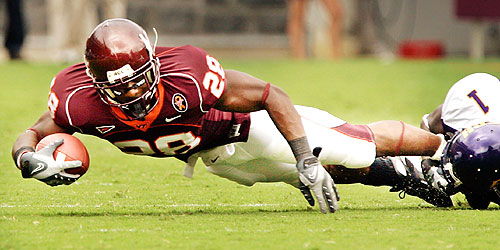
It’s hard to be a stat-head like I am and love college football. There aren’t as many useful stats and there aren’t as many trends as the two most stat-friendly sports, baseball and basketball. Even the box scores for football suck.
Of course, the bad road rushing numbers don’t just follow
The drop-off is even more apparent when the numbers are placed together:
2006: 5 g, 2.1 ypc, 67.4 ypg, 7 td
In 2007, the numbers went up in a season I thought
The only number that didn’t rise significantly was touchdowns. Was this because of
I think the improved numbers, along with
Subscribe to:
Posts (Atom)


 Posts
Posts

